Better Family Photos

  • Subscribe to our RSS feed.
  • Twitter
  • StumbleUpon
  • Reddit
  • Facebook
  • Digg

Monday, 25 March 2013

Nikon D7100 GGS LCD protector

Posted on 01:52 by Unknown
The Nikon D7100 doesn't come with a screen protector, unlike many other Nikon DSLRs.  There is not even a receptacle for adding one.

For my other cameras I always use a GGS LCD protector.  It is a lot clearer than the plastic screen protector, and it provides more protection than the soft type of screen protector.  In fact, it has already saved one of my cameras.  See here.

What about the D7100?  It is so new that there is no GGS protector for it yet.  The good news is that you don't have to wait for one -- the D7100 screen is the same size as that of the D600, and can use the GGS protector for the D600.

But there's a catch...


The D7100 screen was designed to reduce glare and unfortunately, adding a GGS protector removes that benefit.

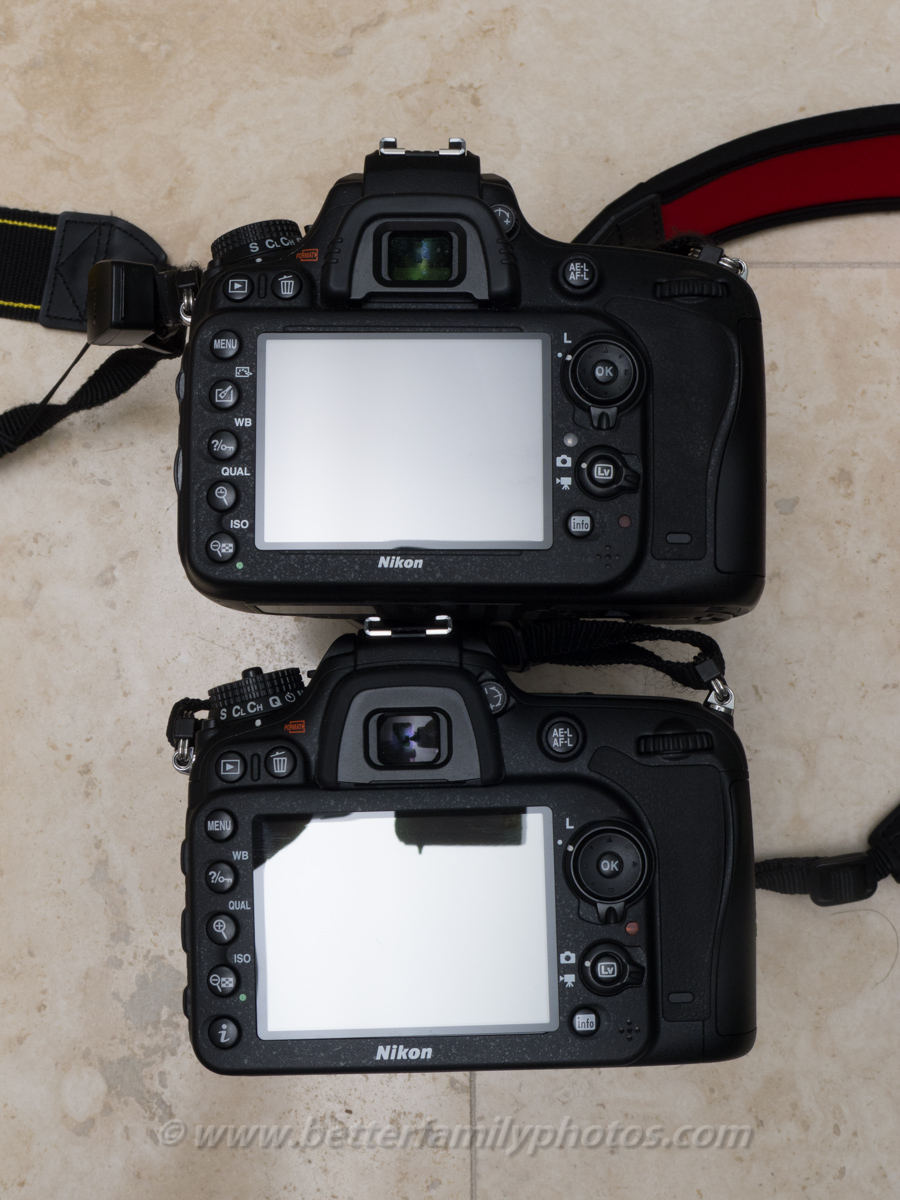
Here is the D600 with a GGS protector on the left.  The one on the right is the D7100, before I attached a GGS protector.  I bounced a flash off the ceiling.  You can see that the reflection of the ceiling on the D600 is brighter than that of the D7100, evidence that the D7100 has better anti-glare properties (note: I don't know how the D600 without the GGS would compare).


After I applied the GGS protector, I did the same test.  Here is how it looks:

Now the reflection is even (there might even be slightly more glare on the D7100).  Here is another view (D600 on top, D7100 on the bottom).


Fortunately, the GGS protector does not diminish the brightness of the screen.  In the shot below, the D7100 still appears brighter than the D600 (D600 on top, D7100 on the bottom).

PSA: If you are interested in the Nikon D7100, you can join the Flickr D7100 Group for samples and the latest discussions.


RELATED POSTS:
Nikon D7100 Hands-On Real World User Review
Nikon D7100 Shadow Recovery
Importing D7100 Raw Files Into Lightroom
Nikon D7100 Real World Dynamic Range
Nikon D7100 Low Light Teaser
Nikon D7100 FAQ and Helpful Links
Nikon D7100 High ISO comparison with D7000, D600 and D700
Read More
Posted in | No comments

Saturday, 23 March 2013

Does Nikon D7100 have dust spots?

Posted on 21:01 by Unknown
One of the few issues with the Nikon D600 is that it has a tendency to get dust spots.  See the related posts here (under 'Dust spots').  Some people are therefore wary that the Nikon D7100 might have the same issue.

In this post, I compare what my sensor looks like when I first got it and what it looks like now, after about 1000 shots.


When I got the D7100, the very first frame I took was a shot of the sky, in order to establish a baseline for the presence of spots (if any).
D7100J-0001-201303141205-2.jpg

With contrast maximized it looks like this:
D7100J-0001-201303141205.jpg

I now have about 1000 shots on the D7100.  Note: I change lenses frequently, at least once every time I use it.  I haven't noticed any spots on my shots.  On the other hand, I usually shoot at wider apertures.  For testing purposes I took a shot at f/16, which is likely as high as I would ever go for normal shooting (normally I shoot at f/8 or wider).

Here is how it looks at f/16:
D7100-1003-201303230930.jpg

With contrast maximized the f/16 shot looks like this:
D7100-1003-201303230930.jpg

For testing purposes I took a shot at f/45:
D7100-1004-201303230932.jpg

Here is the f/45 shot with contrast maximized:
D7100-1004-201303230932-2.jpg

For reference here is what my Fuji S5 sensor looks like (also at f/45):
S5-6123-201303240809.jpg

I tried to remove the dust using the sensor cleaning function and by using a blower but they did not go away.  Anyway, I'm not in a rush to remove them since I don't see them in my shots.  However, I plan to bring it to the shop for cleaning after around 2000 shots.


RELATED POSTS:
Firefly DSC-2000 Review
Nikon D7100 Hands-On Real World User Review
Nikon D7100 Shadow Recovery
Importing D7100 Raw Files Into Lightroom
Nikon D7100 Real World Dynamic Range
Nikon D7100 Low Light Teaser
Nikon D7100 FAQ and Helpful Links
Nikon D7100 High ISO comparison with D7000, D600 and D700
Read More
Posted in | No comments

Friday, 22 March 2013

Imaging Resource posts Nikon D7100 Samples

Posted on 07:25 by Unknown
Imaging Resource has posted Nikon D7100 samples using their standard studio scene, which facilitates comparison with other cameras using their comparometer.


RELATED POSTS:
Nikon D7100 Hands-On Real World User Review
Nikon D7100 Shadow Recovery
Importing D7100 Raw Files Into Lightroom
Nikon D7100 Real World Dynamic Range
Nikon D7100 Low Light Teaser
Nikon D7100 FAQ and Helpful Links
Nikon D7100 High ISO comparison with D7000, D600 and D700
Read More
Posted in | No comments

Nikon D600 vs. Nikon D7100 comparison (daylight)

Posted on 05:53 by Unknown
While I'm still analyzing the D600 and D7100 low light shots, here are more comparison shots between the D600 and D7100, this time in daylight.  For this test, I used the Sigma 35 1.4 on the D7100 and the Tamron 28-75 (at around 52mm) on the D600.  I know, your first reaction is that it's not a fair comparison because the Sigma is considered one of the sharpest lenses, whereas the Tamron is sharp in the center but it's not in the same league.


Nonetheless, I believe the "perceptual megapixels" of the two combinations is probably very close:
Nikon D600 + Tamron 28-75 = 12 Pmp.
Nikon D7000 + Sigma 35 1.4 = 11 Pmp.
Nikon D7100 + Sigma 35 1.4 = ?? Pmp.  My guess is it's not much higher than 11 (see why here -- under "Sharpness").

To keep the comparison more fair, I suggest looking primarily at the center area of each shot (the Tamron loses sharpness as you move toward the edges and corners).

Regarding the shooting conditions, the sky was cloudy and the sun was moving in and out of the clouds, hence the difference in exposures.  BTW you'll notice in the EXIF that the D7100 files are from the "D5200".  That's because I had to change the metadata to import them into Lightroom (see here).

Anyway here are the shots (full resolution available):

SET 1:
D7100-0130-201303141559.jpg
d7100
D600-9466-201303141600.jpg
d600


SET 2:

D7100-0127-201303141555.jpg
d7100

D600-9462-201303141557.jpg
d600


SET 3:

D7100-0121-201303141552.jpg
d7100
D600-9457-201303141554.jpg
d600


SET 4:

D7100-0120-201303141551.jpg
d7100
D600-9456-201303141553.jpg
d600


SET 5:
D7100-0117-201303141545.jpg
d7100
D600-9451-201303141547.jpg
d600


OBSERVATIONS:
Sharpness.  To me, the sharpness looks about evenly matched.  This is not expected for an APS-C camera, which usually is less sharp than a full frame camera, all other factors being equal (see here). Of course, the lens makes a huge difference here.  If I had used a better lens on the D600, such as the Nikon 24-70, the D600 shot would have looked sharper (the Tamron is nowhere close to maximizing the D600's sensor).

Tonality.  The tonality is quite different between these two cameras.  The highlights on the D7100 are brighter and the shadows in the D600 are deeper, even on shots with identical exposures.  Initially I thought it could be the change in light conditions, but the pattern is very consistent and the sharpness of the shadows are identical which implies that the light conditions were the same.  Plus, if it's due to the change in light conditions, I would think that the D7100 shot sometimes shows the reverse pattern. But nope - the tonality is consistent in these shots.

I am wondering if this means that the D7100's tonal curve has a longer, softer shoulder (like the Fuji S5 - reviewed here), a quality which I like because it makes the shot more similar to that of negative film.  By contrast, the D600's tone curve is known to have almost no shoulder (see DPReview's analysis here) even when Active D-Lighting is turned on.  In other words, with the D600, you will see highlights disappear suddenly when they exceed the sensor's highlight range.  If indeed the D7100 has a longer shoulder, then highlight rolloff will be smoother and it will not be very obvious when the highlight has disappeared.

Indeed, that appears to be the case.  If you look at Set 2, specifically at the sunlit portion of the top of the boat, the D7100 looks like it has more delicate and natural-looking highlights.  (See the similarity to the Fuji S5's rendering of the porcelain bowl in our review here.)  In part 2 of my D7100 review, you'll see this as well in shots of people.

To some extent either shot can be made to look more similar to the other (as long as the highlights are not blown during capture), but it is interesting to see the cameras' natural tendencies.


RELATED POSTS
Nikon D7100 Hands-On Real World User Review
Importing D7100 Raw Files Into Lightroom
Nikon D7100 Low Light Teaser
Nikon D7100 FAQ and Helpful Links

Nikon D7100 Shadow Recovery
Nikon D7100 Real World Dynamic Range
Nikon D5200 and D7100 Band-Aid: Solutions for Banding
Sample of D7100 banding in a real world shot


Read More
Posted in D600, D7100, fuji, highlight, nikon, s5, shadow, sharpness, tonality, tone curve | No comments

Thursday, 21 March 2013

Choosing between full frame vs. APS-C

Posted on 06:31 by Unknown
I know some of us are choosing between a full frame camera and an APS-C camera, such as the D600 and the D7100.  The purpose of this post is to highlight some of the differences to help you reach an informed decision.


1. Low light.
One typical advantage of full frame cameras is better low light capability.  Some would say that you can use flash in low light.  Of course you can.  But low light capability can complement flash use, not only increasing the potential range of your flash but also making it easier to mix the flash and ambient for natural-looking results.
Nikon D600 with flash. ISO 12,800.

Moreover there are times when using a flash is difficult.  In the shot below, the background was cavernous, and the black ceilings would have been difficult to bounce from.  At the same time we were constantly moving, therefore a long exposure would have resulted in a blurry shot.  Thanks to the D3's high ISO capability, I could use a shutter speed as high as 1/160 (f/2.8, ISO 12,800) for a sharp shot.
Nikon D3 with Tokina 11-16 at 16mm, f/2.8, 12,800 ISO.
The better argument in my view is that a full frame camera no longer has an obvious advantage over APS-C for low light.  With new high-performing APS-C cameras, you would have to look at specific cameras to draw a conclusion.  For example, DXO scores notwithstanding, I believe a Nikon D7100 can have a comparable image quality to the Nikon D3, with both at 12,800 ISO, if the D7100 shot is reduced to the same resolution, especially if both are viewed at laptop viewing sizes. [UPDATE: I have confirmed that, as incredible as it sounds, the D7100 does indeed have the same high ISO performance as the D700/D3 when viewed at the same 12mp size.  See here.]

D7100-0961-201303200058.jpg
Nikon D7100 at 12,800 ISO (with flash). No noise reduction yet.
2. Sharpness.
All factors being equal, a full frame camera will be sharper than an APS-C camera.  I know there are skeptics out there so let's look at DXO scores for the Sigma 35 1.4, one of the sharpest lenses ever made.

On a 6mp Nikon D70, the Sigma 35 1.4 has a resolution of 6 perceptual megapixels (i.e. the lens outresolves the sensor).  On the higher resolution sensor of the 12mp Nikon D300S, the Sigma 35 1.4 has a resolution of 10 pmp, a nearly proportionate increase of total resolution.  On the 16mp Nikon D7000, however, the Sigma 35 1.4 only has a resolution of 11 pmp.


Although there is a significant increase in sensor resolution from the D300S to the D7000, the increase in total system resolution is marginal.  It appears the lens has reached its limit.

Or has it?  If we compare the Sigma 35 1.4 on the D7000 with the Nikon D4 which also has 16mp, the system resolution jumps to 14pmp.  This alone should tell you that all factors being equal, full frame cameras will give a sharper image than APS-C.  However, that's not the end of the story.  If you go still higher to a 24mp Nikon D3x, the total system resolution leaps to 20 pmp.  In fact, you may have heard that on the D800, the Sigma 35 1.4 reaches as high as 23 pmp.  So in fact, the Sigma has far greater potential resolution than the D7000 result would imply.


The explanation is simple: an APS-C camera has smaller pixels than a full frame camera, and a lens has to have a higher resolution in order to fully utilize the resolution of a sensor with smaller pixels.  Below a certain pixel size, a lens has to be extremely sharp to match the sensor resolution.  The Sigma 35 1.4 is already one of the sharpest lenses out there but even the Sigma cannot fully use the 16mp resolution of the D7000.  This is why I think that if DXO tests the Sigma 35 1.4 on the 24mp D7100 or D5200, the increase in resolution will be marginal.  Hopefully, in the future, manufacturers step up and design higher resolution lenses for APS-C (there are after all many high resolution Micro 4/3 lenses).  For now, though, there aren't any.  See the list of sharpest lenses for DX here.

Of course there are other factors that affect sharpness (duh!).  Nonetheless, if we stick to the issue of whether a full frame camera is sharper, the answer is that indeed, a full frame camera has a higher potential for sharpness than an APS-C camera.

3. Depth of field.
85 1.8G on Nikon D600

A full frame camera using a lens with the same field of view as an APS-C camera will appear to have a shallower depth of field, all other factors being equal (same distance to subject, same distance to background, same aperture).  However, one counterargument is that you CAN achieve a very shallow DOF on an APS-C camera as well, such as by using a longer focal length, moving closer to the subject, etc.

28-105 @ 105mm f/4.5 on Nikon D7100
Moreover, sometimes a very shallow DOF is not practical.  For example, if you use a 70-200 at f/2.8 on full frame to take a photo of a couple of people, the DOF is usually not deep enough to keep both faces in focus, unless they are exactly at the same distance to the camera.

On the other hand, at wider focal lengths, it is not easy to achieve a shallow DOF on APS-C, this gives wide-aperture wide angle full frame shots a distinctive appearance.
28 1.8G on Nikon D600
I personally believe that after we all have looked at many photos, we gain an intuitive expectation of the DOF of an APS-C camera as opposed to full frame, and when we see a shot with unusually shallow DOF at a wide angle, we recognize it as a full frame shot.  In fact, I would go even further. You know how some people say that full frame has a certain 'look' but they can't put it into words?  I think what gives full frame that distinctive appearance is the unexpectedly shallow DOF.

Sigma 50 1.4 on Nikon D600


4. Cost vs. versatility.
24-70 on full frame (Nikon D3)
One deterrent for getting a full frame camera is the cost of lenses.  It is true that full frame lenses generally cost more than their APS-C-only counterpart.  However, if you have an APS-C as a second camera, a full frame lens can function as two different focal lengths.  For example, the 24-70 2.8 is great as a standard zoom on full frame.  On APS-C it can work as a portrait lens.

24-70 on APS-C (Nikon D90)

5. Wider angles vs. reach.
The conventional thinking is that full frame is better for wider angles because at the same focal length, you'll have a wider field of view, while APS-C is better for longer focal lengths because at the same focal length, you'll have a longer equivalent focal length.

I think this is not a big factor.  There are wide angle lenses specifically designed for APS-C that will allow a wide field of view.  For example, the Sigma 8-16 can have a field of view as wide as a 12mm full frame lens.  That's just the same as the widest full frame ultrawide, the Sigma 12-24.

Sigma 10-20 @ 12mm on Fuji S5, an APS-C DSLR
As for reach, a full frame image can be cropped to have a smaller equivalent field of view (plus you have more flexibility for choosing the framing).  So I think the key issue is the resolution of the cameras you're comparing. For example, if you're comparing a D3 (12mp) and D7100 (24mp) then the D7100 will probably come out ahead because the DX-cropped D3 image will only have about 5mp, a much lower resolution than the D7100 (do consider other factors such as noise, etc.).  On the other hand if you're comparing a D800 (36mp) with a D70 (6mp) then the DX-cropped D800 image will have about 15mp, while the D70 has only 6mp, therefore the DX-cropped D800 image will probably be better (indeed at least one comparison of the D800 DX crop to the D7000 shows that the cropped D800 image is comparable to the D7000).

EPILOGUE
As you can see, the choice between full frame or APS-C really depends on what kinds of photos you take.  Personally, I like having the versatility of having both a full frame and APS-C camera.  When I want shallower DOF, such as on a standard zoom, I use full frame.  When I want a deeper DOF, such as an ultrawide or fast telephoto zoom, I use an APS-C camera.

RELATED POSTS:
Full Frame DSLR FAQ
Comparison of DOF between APS-C and FF in Depth of Field of Kit Lenses
Read More
Posted in | No comments

Wednesday, 20 March 2013

The Sharpest Lenses for Nikon DX (APS-C) format

Posted on 13:06 by Unknown
Are you wondering what are the sharpest lenses that you can use for your DX camera?  Here are the top 3, among those measured by DXO: the Sigma 35 1.4, Nikon 85 1.4G, and Nikon 85 1.8G!
Inline image 1
The 3 lenses above have resolution of 11 'perceptual megapixels' on the D7000.  (DXO hasn't posted tests of these lenses on the D7100 or any DX body with a higher resolution than the 16mp D7000.)

Hit the jump for the list of the other sharpest lenses...
 

Though these lenses aren't as sharp as the top 3, they are still very sharp.  Here are the lenses that have a resolution of 10 P-Mpix in DX on the D7000, arranged by focal length.

Samyang 14 2.8
Zeiss 28 f/2 ZF2
Nikon 35 1.4G
Nikon Micro 40 2.8G
Nikon 50 1.4G
Nikon 50 1.8D
Nikon 50 1.4D
Zeiss 50 f/2 ZF2
Tamron 60 f/2
Samyang 85 1.4
Zeiss 85 1.4 ZF2
Nikon 85 1.4D
Nikon 85 1.8D
Sigma 105 2.8 OS

Finally, there is one more lens that made it to 10 P-Mpix on the DX, in fact it is the only zoom lens to do so! Drumroll please.... the Sigma 17-50 OS!

Update: As pointed out by Xiaoli in the comment below, Sigma will be releasing a new DX-only lens soon that is part of the Art series (the same family as the Sigma 35 1.4): the 30 1.4.  Given that it is specifically designed for DX, I'm curious how well it will perform!

RELATED POSTS
Samples of Sigma 35 1.4 on Nikon D7100 in our detailed real world D7100 review
Sigma 35 1.4 preview - with D600
Nikon 85 1.8G review - with D600
Read More
Posted in | No comments

Nikon D7100 vs. Nikon D600 low light test shots - preview

Posted on 08:21 by Unknown

D7100-0925-201303192347.jpg

I took some test shots to compare the D7100 and D600 image quality in low light.  I haven't had the time to write them up but if you want to check out the full resolution shots *right now*, here they are:

D7100 Low Light Test Shots
D600 Low Light Test Shots


RELATED POSTS
Nikon D7100 Hands-On Real World User Review
Importing D7100 Raw Files Into Lightroom
Nikon D7100 Low Light Teaser
Nikon D7100 FAQ and Helpful Links
Nikon D7100 Shadow Recovery
Nikon D7100 Real World Dynamic Range
Nikon D5200 and D7100 Band-Aid: Solutions for Banding
Sample of D7100 banding in a real world shot


Also check out the Flickr D7100 Group for samples and the latest discussions about the D7100.
Read More
Posted in | No comments
Newer Posts Older Posts Home
Subscribe to: Posts (Atom)

Popular Posts

  • Samyang 24 f/3.5 Tilt Shift Lens Now Available
    A seller on ebay ( bestpriceoptics ) is now selling the Samyang 24 f/3.5 tilt shift lens, in Canon and Nikon mounts, for $999 shipped.  This...
  • Nikon 28 1.8G: Moody Artist?
    When Nikon had its recently-finished sale (now extended to end of March), the one lens that I considered buying was the Nikkor 28 1.8G.  To...
  • Olympus E-PL3 with 14-42 Lens $199; Moving from Nikon to MFT?
    I saw on 43rumors.com that the Olympus E-PL3 was being sold at Newegg for just $199 with the 14-42 kit lens included.  I checked it out and...
  • Double Camera Strap & BlackRapid RS-5 Review
    This is a review of two camera straps: - The first is a double camera strap that's -- let's be blunt -- a knockoff of the BlackRapid...
  • Price drops!!! Olympus XZ-2, Pentax MX-1. And about the Casio EX-10
    I just noticed a huge price drop on the Olympus XZ-2 (previously $500 now under $400) and Pentax MX-1 (previously $500 now under $300 ).  Pe...
  • Best Alternative to Nikon 24-70 2.8G: the Nikon 28-70 2.8D
    Every Nikon shooter knows that the Nikkor 24-70 2.8G is the best standard zoom for Nikon's full frame cameras.  However, at around $1900...
  • Abstract Fun
    In one of the rare times I put effort and setup a light stand and an umbrella to shoot my girls, I decided to make use of this burst of ener...
  • Coco Ring Flash - First Impressions
    A few weeks ago, after much deliberation, I finally decided to get a ring flash adapter.  My purpose was to use it as on-axis fill, much lik...
  • Nikon D7000 vs. Nikon D7100
    D7000 + Tokina 11-16 I've been using the Nikon D7000 for a couple of months now, and in this post I'd like to share my thoughts on t...
  • Sigma 18-35 1.8 Revisited; Where to Get It
    Back in April of this year, Sigma surprised everyone by announcing the Sigma 18-35 f/1.8 , the first zoom lens for a large sensor that had s...

Categories

  • "alien bee"
  • "april fool's"
  • "ring flash"
  • "yong nuo"
  • 1"
  • 1/1.7"
  • 10-17
  • 10-20
  • 11-16
  • 15-85mm
  • 15z
  • 17-50 vc
  • 190cx pro3
  • 2.8
  • 2.8G
  • 2/3"
  • 200 f2.8
  • 200 L
  • 200mm
  • 200mm f/2.8
  • 200mm f/2.8 L II
  • 200mm f2.8
  • 200mm f28
  • 200mm f28 L II
  • 2012
  • 2013
  • 23 Samsung led
  • 24-105 f4
  • 24-70
  • 25 1.4
  • 28-105
  • 28-70
  • 35mm
  • 35mm f/2
  • 35mm f2
  • 360
  • 3rd party
  • 4.1
  • 4/3
  • 40 pancake
  • 40 panckae
  • 40 stm
  • 40-150R
  • 40mm f/2.8
  • 430EX
  • 43rumors
  • 45 18
  • 45 AW
  • 4x4
  • 50 14
  • 50 f14
  • 50-150
  • 50mm
  • 50mm f/1.4
  • 55 AW
  • 55-250
  • 550D
  • 55aw
  • 560ex
  • 580 ex ii
  • 580EX
  • 580EX II
  • 5d
  • 5d mark 2
  • 5d mark 3
  • 5D Mark II
  • 5d mark iii
  • 5d2
  • 600d
  • 600ex-rt
  • 60d
  • 60fps
  • 60mm macro
  • 650d
  • 6d
  • 7.5mm
  • 720p
  • 75 f1.8
  • 85mm f1.8
  • 8x12
  • abbc
  • abstract
  • accuracy
  • active d-lighting
  • adjustment
  • adl
  • AF
  • af point
  • AF Point Expansion
  • aftermarket
  • airport
  • alexandria
  • alien bee
  • alien bees
  • alienbee
  • alienbees
  • alternative
  • ambient
  • ambient light
  • angle
  • aperture priority
  • APS-C
  • apsc
  • assignment
  • auto focus
  • auto white balance
  • autofocus
  • AWB
  • awl
  • back button focus
  • background
  • background blur
  • backlight
  • backlighting
  • backlit
  • bad behavior
  • bad photography
  • balance
  • bare flash
  • battery
  • BBF
  • beach
  • beams
  • beauty dish
  • bellagio
  • BFT
  • birthday
  • black
  • black foamie thing
  • black rapid
  • blackrapid
  • blogs
  • blower
  • blown
  • blur
  • bokeh
  • bounce
  • bounce card
  • bounce flash
  • bower
  • bracket
  • brightness
  • brilliance
  • brolly grip
  • brother
  • build
  • burst mode
  • butterflies
  • butterfly
  • C.Fn
  • cable
  • cake
  • camera
  • camera bag
  • camera releases
  • camera settings
  • candle
  • candlelight
  • canon
  • Canon 100mm Macro L IS
  • canon 200mm f28L
  • canon 24-105
  • canon 40 stm
  • canon 40mm f28 pancake
  • canon 50
  • canon 50 1.4
  • canon 55-250
  • canon 5d mark 2
  • canon 5d mark ii
  • canon 5d mark iii
  • canon 5d2
  • canon 5d3
  • Canon 60d
  • canon 6d
  • canon g11
  • canon speedlite
  • car
  • carbon fiber
  • catch lights
  • cheap
  • christmas
  • clean
  • cleaning
  • clipped
  • clipping
  • close up
  • clouds
  • cls
  • clustered
  • color
  • compact
  • comparison
  • composition
  • compositional aid
  • construction
  • contrast
  • cooler master
  • copyright
  • core i7
  • cowboy
  • cowboystudio
  • cpl
  • creepy
  • crop factor
  • crop sensor
  • cyber commander
  • cybersync
  • d-lux
  • d-lux5
  • d3
  • d300
  • D5100
  • D600
  • d70
  • d700
  • D7100
  • d90
  • dark background
  • david hobby
  • daylight
  • dell 24 inch
  • depth of field
  • desert
  • diamond
  • digital
  • directional
  • distance
  • diy
  • dlux
  • dlux5
  • dng
  • double
  • dslr
  • DSLR bag
  • dual
  • dust
  • dx
  • dynamic range
  • earthquake
  • ebay
  • ebay trigger
  • eclipse
  • editing
  • EF 40mm f/2.8
  • ef-s 60mm
  • einstein
  • Electro GN
  • engagement
  • environmental portrait
  • ep5
  • equipment
  • ETTL
  • ettr
  • europe
  • events
  • evf
  • ex600
  • existing light
  • expensive
  • exposing to the right
  • exposure
  • f/3.5
  • family
  • faq
  • fasten-r3
  • favorite
  • fayoum
  • Fayoum desert
  • fill
  • fill light
  • film
  • filter
  • finepix
  • fire
  • fireplace
  • first impressions
  • fish-eye
  • fisheye
  • fix
  • FL600R
  • flash
  • flash bounce
  • flash sync
  • flash trigger
  • flashmeter
  • flashright
  • focal length
  • focus
  • food
  • football
  • fotodiox
  • fountain
  • freexwire
  • fuji
  • fujifilm
  • Full Frame
  • fun
  • fx
  • galaxy s 3
  • galaxy s4
  • gecko
  • GeForce gtx570 OC
  • gel
  • geomag
  • ggs
  • ghost
  • gigabyte z77 ud3h
  • glass
  • gn
  • Goodbye
  • gorillapod
  • gregg
  • grid
  • grip
  • group shot
  • gskill ripjaws
  • guide
  • guide number
  • gx7
  • haf 912
  • handheld
  • hands on
  • hands-on
  • hdr
  • head shot
  • hiatus
  • high dynamic range
  • high iso
  • high speed sync
  • highlight
  • highlights
  • histogram
  • holder
  • holiday
  • home
  • home made
  • Honda civic
  • honeycomb
  • hotshoe
  • hoya
  • humor
  • i9500
  • id
  • image quality
  • impressions
  • indoor flash
  • infrared
  • infringement
  • insects
  • inverse square law
  • japan
  • jewel
  • jewelry
  • joby head
  • jpeg
  • Kingston hyperX SSD
  • kirk tuck
  • kl bird park
  • krakow
  • kuala lumpur
  • las vegas
  • lastolite
  • laurence kim
  • lax
  • lcd
  • leica
  • lens
  • lens cap
  • lens compression
  • lens review
  • lenses
  • lenspen
  • lensrentals
  • light
  • light painting
  • lighting
  • lightroom
  • lightroom 4
  • lightroom 5
  • location
  • long
  • long exposure
  • los angeles
  • low key
  • low light
  • Lowepro
  • Lowepro 45aw
  • Lowepro 55aw
  • lr4
  • lumiquest softbox III
  • lumix
  • lx-5
  • lx5
  • m4/3
  • m43
  • macro
  • macro adapter
  • makernotes
  • malaysia
  • manfrotto
  • manfrotto tripod
  • manual
  • mark ii
  • mark iii
  • MFT
  • mft. micro four thirds
  • micro four thirds
  • mielec
  • migration
  • mini review
  • mirror
  • mirror-less
  • mirrorless
  • mobile
  • modification
  • modifier
  • monobloc
  • monoblock
  • monolight
  • motion
  • motion blur
  • multi function printer
  • multiple
  • nano crystal
  • natural light
  • neil
  • Neil VN
  • niekerk
  • nikkor
  • nikon
  • nikon d600
  • noise
  • off camera
  • oil
  • olympus
  • olympus 12-50
  • Olympus 40-150
  • olympus 45
  • olympus 45 18
  • olympus om-d em-5
  • om-d
  • omd
  • omd em1
  • omd em5
  • omd em6
  • on-camera
  • one inch
  • overexposure
  • overpowering sun
  • panasonic
  • panasonic leica 25 14
  • pancake
  • party
  • passport
  • pastries
  • pastry
  • pc
  • pentax
  • peter
  • phone
  • phone photography
  • photo
  • photo tips
  • photography
  • photokina
  • photomerge
  • photoshop
  • photoshop elements
  • planning
  • pocketwizard
  • point and shoot
  • poland
  • polarizer
  • popup
  • popup flash
  • portrait
  • post processing
  • post-processing
  • postprocessing
  • product
  • product shots
  • profile
  • protection
  • protector
  • quad-flash
  • quantum
  • radiopopper
  • raid 0
  • Range finder
  • raw
  • raw editing
  • raw+jpeg
  • rays
  • real
  • recovery
  • reflection
  • reflector
  • resources
  • restaurant
  • review
  • rf-603
  • rf603
  • ricoh
  • ring
  • ringflash
  • robin wong
  • roger cicala
  • rogue
  • rokinon
  • roll off
  • roll-off
  • rolloff
  • rs-5
  • rs-7
  • rumors
  • s5
  • s5 pro
  • s5pro
  • samples
  • samsung
  • samyang
  • sb-26
  • sb-80
  • sb26
  • sb800
  • screen protector
  • sensor
  • sensor swab
  • sensorclear
  • sensorklean
  • sensorklear
  • separation
  • shadow
  • shadow pulling
  • shadows
  • shards
  • sharpening
  • sharpness
  • shoot through
  • shoot-through
  • shoot-thru
  • shooting technique
  • shootout
  • short
  • sigma
  • sigma 50-150
  • skin tones
  • skylight
  • Slik Mini Tripod
  • slingshot
  • slow
  • small
  • smooth
  • soft
  • softbox
  • sony
  • sony a99
  • sony rx100
  • sony t10
  • specular
  • speed
  • speedlight
  • speedlite
  • spinlight
  • spots
  • standard
  • stockholm
  • story
  • strap
  • strobe
  • strobist
  • studio
  • studio strobe
  • subject
  • substitute
  • sudden
  • summilux
  • sunrise
  • sunset
  • sweden
  • swivel
  • sync speed
  • t2i
  • t3i
  • Table top tripod
  • tamron
  • technique
  • techniques
  • tele
  • telephoto
  • thinktank retrospective 5
  • third party
  • tips
  • tokina
  • tonal
  • tonality
  • tone curve
  • toploader
  • toys
  • translucent
  • travel photography
  • tri-flash
  • Tribute
  • trifold
  • trigger
  • tripod
  • truth
  • ttl
  • TTL Cord
  • u43
  • ultra-wide
  • ultrawide
  • umbrella
  • underexposure
  • unlimited sync speed
  • up-rise
  • up-rise 15z
  • update
  • uprise
  • USM
  • uv
  • uwa
  • vanguard
  • versus
  • vertical
  • video
  • view nx2
  • visual science lab
  • vs
  • wadi rayan
  • wd caviar black
  • web
  • weekend
  • westin
  • white balance
  • white lightning
  • wide
  • wide angle
  • window
  • wireless
  • wireless flash
  • wireless release
  • wireless trigger
  • workflow
  • Yashica
  • yashica gtn
  • yashica st-7
  • yn-560
  • yn-560ex
  • yn-ex600
  • yn560
  • yong nuo
  • yongnuo
  • zack arias
  • zoom
  • zoom toploader
  • zuiko

Blog Archive

  • ▼  2013 (165)
    • ▼  December (5)
      • Olympus E-PL3 with 14-42 Lens $199; Moving from Ni...
      • Sigma 18-35 1.8 Revisited; Where to Get It
      • Speedlight Modifiers - 50% discount at Fotodiox
      • Olympus M.Zuiko 45mm f/1.8 Mini Review
      • Evening Portraits with Flash
    • ►  November (10)
    • ►  October (8)
    • ►  September (7)
    • ►  August (3)
    • ►  July (11)
    • ►  June (10)
    • ►  May (15)
    • ►  April (19)
    • ►  March (33)
    • ►  February (24)
    • ►  January (20)
  • ►  2012 (193)
    • ►  December (17)
    • ►  November (22)
    • ►  October (34)
    • ►  September (47)
    • ►  August (12)
    • ►  July (11)
    • ►  June (10)
    • ►  May (13)
    • ►  April (13)
    • ►  March (8)
    • ►  February (1)
    • ►  January (5)
  • ►  2011 (141)
    • ►  December (8)
    • ►  November (8)
    • ►  October (7)
    • ►  September (9)
    • ►  August (13)
    • ►  July (13)
    • ►  June (19)
    • ►  May (17)
    • ►  April (25)
    • ►  March (22)
Powered by Blogger.

About Me

Unknown
View my complete profile