Better Family Photos

  • Subscribe to our RSS feed.
  • Twitter
  • StumbleUpon
  • Reddit
  • Facebook
  • Digg

Monday, 9 May 2011

Right-Brained Guide to Combining the Guide Number of Multiple Flashes

Posted on 23:41 by Unknown
What's the guide number of two identical flashes?  That's easy enough.  It's about 1.4 times the guide number of one flash.  But what if you need to know the combined guide number of several different flashes with different guide numbers?  That's easy too -- just count the photons.  (I'm just half-kidding.)

If you have two or more speedlights or are thinking of getting a few, and you'd like to know what the combined guide number is supposed to be, I promise that no matter how much you may hate math, you'll be able to calculate it using a regular (not scientific) calculator after the jump.  I'll also promise to use a common sense approach and keep the math minimal.

BACKSTORY
Last week, I posted about studio strobes and although I know that studio strobes are more cost-effective when it comes to sheer power, I still want the versatility of using multiple speedlights (hotshoe flash).  I decided to add a couple of flashes to my gear - an SB-26 and another SB-600, with the thought of getting a studio strobe later if I find it absolutely necessary.  (The SB-600 was hard for me to swallow because I had purchased an extra brand new one a few months ago but returned it unused and now I bought a used one at the same price... argh!)


Guide Number - A Review
The guide number (GN) of a flash is a measure of its light output, especially for speedlights (not so much studio strobes due to other variables).  It's not an arbitrary number.  Rather this meaningful measurement can tell you the distance that the flash can adequately illuminate a subject at a particular aperture.  If at 10 feet, you have enough flash power that you can use a fairly narrow f/11 aperture, then the GN is 10 feet x 11 or 110 feet.  (More precisely, the GN is the f-number of the aperture times the distance.)

To make GNs comparable, it is important to make sure that GNs are based on the same ISO, same zoom setting on the flash, and same unit (such as feet or meters).

Before we get down to the business of combining guide numbers, let's take a quick detour.


Inverse Square Law - A Review for Non-Mathematicians
The inverse square law tells us that the intensity of a light source diminishes rapidly as we move away from the light source.  But have you wondered why the inverse square law applies to light (more precisely, to a point light source)?  It's not because the light disappears (any grade school kid knows that energy cannot be destroyed).  Rather it's because the light energy gets spread out.  You can almost imagine the tiny photons from a glowing sphere of light shooting out into space in straight lines with the straight lines spreading further and further apart from each other as the photons travel farther away from their home.

The photons spread out horizontally, so we divide the number of photons (i.e. the intensity of light) by the distance to account for the horizontal spread.  If they spread out horizontally only then we wouldn't need the inverse square law.  It would just be called the inverse law. :)  But of course the photons will also spread out vertically, so we have to divide the horizontally spread-out photons vertically as well by dividing the intensity with the distance again, to account for the vertical spread.  In other words, we divide the intensity by the distance squared.  Some might even say the intensity is inversely proportional to the square of its distance. :)

What's this gotta do with combining the GN?  Well as I said, to combine GNs we just count the photons.

COMBINING GUIDE NUMBERS
We could re-imagine GN as a measure of the photons a flash can put out.  Let's take the Nikon SB-800 as an example.  Its GN is 125 feet (35mm zoom, 100 ISO).  Wow - 125 feet is pretty far.  What's even more amazing is that for the light to reach 125 feet while taking into account the inverse square law, we would need 125 x 125 or 15,625 "photons" to get there.

Now suppose we had an SB-800 (GN: 125 feet), two SB-600s (GN: 98 feet each), and an SB-26 (GN: 118 feet).  Lots of photons there.  Let's count them:
SB-800: 15,625 photons
SB-26: 13,924 photons
first SB-600: 9,604 photons
second SB-600: 9,604 photons
Total: 48,757 photons.

How far could 48,757 photons go?  Well, thanks to the darned inverse square law, we have to spread those photons vertically and horizontally by getting the square root of 48,757.  Turns out that's around 220 feet.  Well, there sir (or madam) is your combined GN.

To recap:
1. Determine the guide number of each flash, at same zoom, same ISO, same unit. e.g. 35mm ISO 100, in feet.
2. Count the "photons" of each flash (by squaring the distance).
3. Add the "photons" of the flashes.
4. See how far the total photons can reach under the inverse square law by getting the square root.
You're done!

If you want to double-check your calculations, try out this spreadsheet.

EPILOGUE
Going back to why I got two more flashes instead of a studio strobe, how does a GN of 220 feet compare to the power of a studio strobe?  According to the Paul Buff Alien Bees website, their B1600 fitted with a standard 7-inch reflector (80 degree coverage) has a GN of 236 feet.  So, on paper, if we forget coverage for the moment, the combined GN of my 4-flash setup delivers almost as much light intensity as a B1600.

Note though that at 35mm, the speedlight coverage is only 45 degrees vertically and 60 degrees horizontally according to Nikon.  If we use an 11-inch reflector on the B1600 with 50 degree coverage, then the GN jumps to 450 feet.  The 4-flash setup GN of 220 feet would be more like a B400 with an 11-inch reflector.  So I still have an excuse to get a studio strobe in the future. :)

Meanwhile, how would I trigger all 4 speedlights and control them simultaneously?  Triggering options for a multi-flash setup will be an upcoming post.

RELATED POSTS:
Stop Thinking
Read More
Posted in flash, gn, guide number, inverse square law, multiple | No comments

Sunday, 8 May 2011

Easiest DIY Infrared Filter

Posted on 01:11 by Unknown

If you have a popup flash that can act as a wireless flash commander but want to block the popup from contributing to the exposure, there are a few options out there such as the Nikon SG-3IR infrared panel (which can also work for Canon with some modification).  You can also create your own infrared panel using negative film that has been exposed and developed.  But the easiest DIY version is to use a floppy disk.


It's a little hard to find a 5.25 inch diskette, but 3.5 inch disks can still be found every now and then.  Try thrift stores and dollar stores.  Once you find some, it's easy to take a disk apart even without tools.


What I then do is to fold the magnetic disk into half, then half again to 1/4th its original size, then wrap it around the popup flash with tape. Voila... an instant DIY infrared filter.


With this filter, the visible light from the popup flash will be reduced significantly, but you'll still be able to trigger other flashes optically.
Read More
Posted in diy, filter, infrared, popup flash | No comments

Friday, 6 May 2011

Will It Bounce? Part 3: School Concert

Posted on 07:06 by Unknown
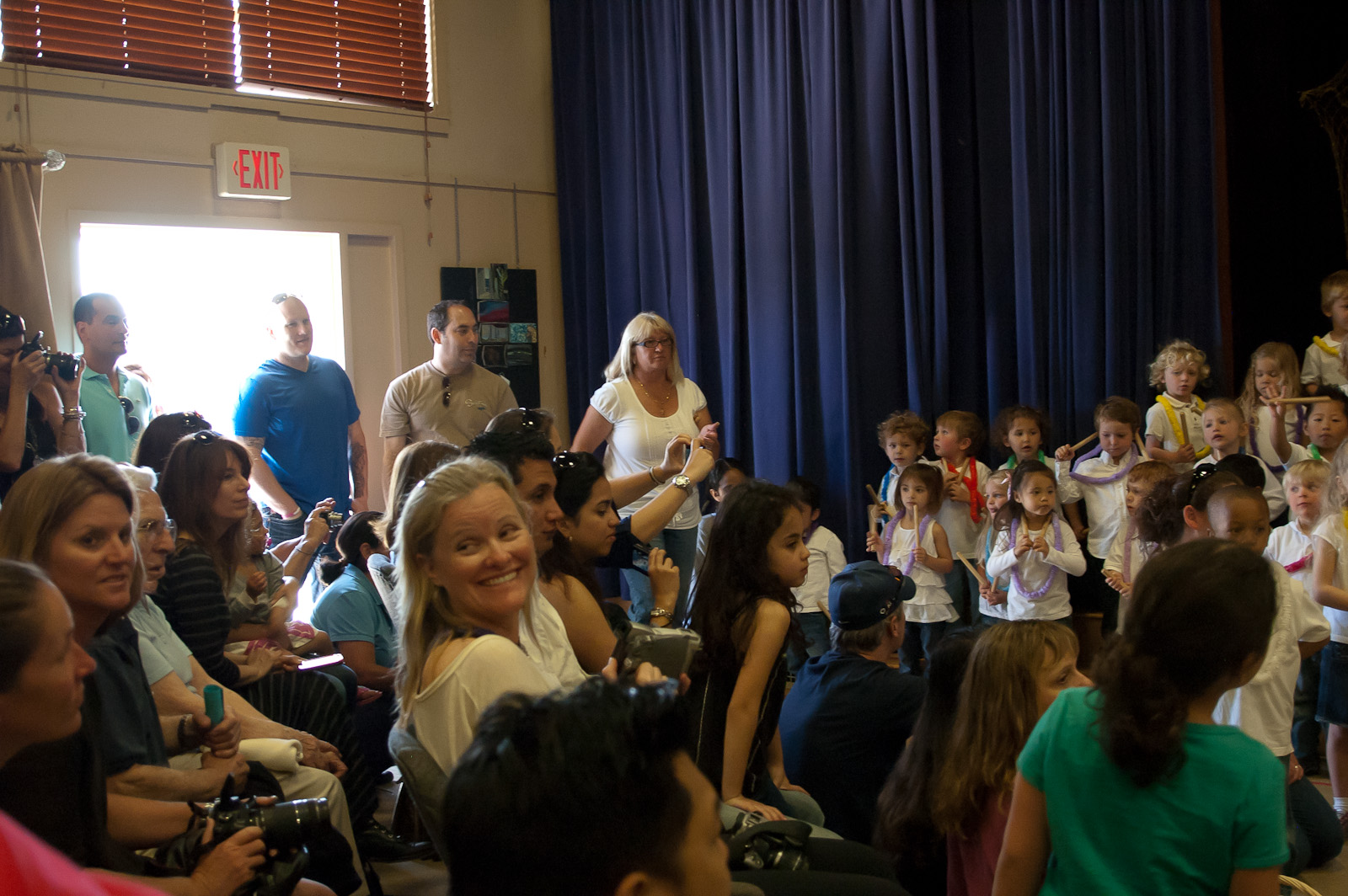
Ever had to shoot in a small auditorium and wondered whether you could bounce flash?

Our toddler had a school concert last week.  The auditorium had ceilings that were navy-blue and about 20 to 25 feet high.  The room had fluorescent lights overhead, but a significant part of the ambient light was coming from a door on camera left.  The ambient exposure was around f/4.5, 1/80, ISO 1600.  I had with me only an old zoom lens Nikkor 28-105 f/3.5-4.5 AF-D, a D70 (tops out at ISO 1600), and an SB-800.

Navy blue ceilings

Ambient was from a door and from fluorescent lights overhead.
At first I tried ambient only but the shots looked a little blurry.  My effective focal length was around 157.5 mm and my shutter speed was only 1/80.
Ambient only.  Straight out of the camera.
It was also underexposed.  But my ISO was already at its maximum and my aperture at its widest.  If I had used a slower shutter speed, the shots would have been even more blurry.  I opted to keep my exposure as is and adjust the exposure in post-processing (effectively pushing the ISO).

Meanwhile I started to wonder whether I could bounce the flash.  They were kind of high and quite dark (almost black).  But I thought it was worth a shot.  I bounced the flash straight up (in some cases slightly tilted forward or slightly tilted camera left).  And here's what I got:

No flash vs. With flash.  Straight out of the camera.
Definite improvement.  Later, during post-processing, I adjusted the ambient-only shot.  Not as clean as the shot with the flash:

RELATED POSTS:
Will it Bounce? Part 1: Pergola
Will it Bounce? Part 2: Very Blue Fabric
Extreme Bounce Flash
12 Alternatives to Bouncing from Ceilings and Walls

Anyway, here are some more shots, all with bounce flash:


Read More
Posted in ambient, bounce, flash, lighting | No comments

Wednesday, 4 May 2011

Au Naturel

Posted on 07:15 by Unknown

I often use flash.  Sometimes it's because the ambient is too dim, but more often it's to enhance existing light.  However, the ambient light can be perfect as is.

In the shot above, we were shaded by a building but there was sunlight bouncing off a wall on camera left, about 20 feet away:


The reflected light was enough to cast a glow on my wife's face.  If I had used flash, the reflected light would likely have been overpowered.
Read More
Posted in ambient light, existing light, flash, lighting, natural light, reflector | No comments

Tuesday, 3 May 2011

Intro to Studio Strobes

Posted on 07:40 by Unknown
Lately I've been thinking about doing more setup shots, especially location shots.  Outdoors you usually need more power because of the much brighter ambient conditions, especially with the days getting longer (at least in the northern hemisphere).  In terms of capacity to overpower the sun (even with a large modifier), a studio strobe is much more powerful than hotshoe flashes.  If you don't know anything about strobes, this post is for you.
BTW, strobes can mean different things to people.  I use the term to refer to big flashes.  First, I'll discuss their advantages and disadvantages compared to hotshoe flashes.  Next I'll talk about the main types of strobes.  I'll then discuss the strobe that I'd like to get, then finally I'll talk about remote adjustment options.

ADVANTAGES and DISADVANTAGES
+ Strobes are far more powerful than hotshoe flashes.  An Alien Bee B1600 for example, is approximately equivalent to ten SB-800s or about twenty SB-700s.  On the other hand, sometimes they are too powerful (such as when you want to use a wide aperture to get shallow depth of field).
+ Unlike hotshoe flashes whose flash tubes are recessed in the flash head, strobes have flash tubes that stick out, allowing the light to spread out in all directions, which makes them more suitable for modifiers such as softboxes -- no tupperware needed either. :) 
+ Many strobes also offer modeling lights (i.e., continuous lights that allow you to get a better idea of what the flash will look like).  My SB-800 does have a modeling light but it's pretty weak and pulses like a disco strobe light.
+ Fast recycling time.  An external battery pack for a hotshoe flash can mitigate this advantage somewhat but strobes can fire off shots quickly and take longer to overheat.
On the other hand:
- strobes are generally larger, and they need either an AC power outlet or a separate battery pack (battery-powered strobes being somewhat of an exception). 
- Their upfront cost is also much higher than speedlights although if you try to amass speedlights with equivalent power, using strobes can be more cost-effective. 
- Most strobes can only be used in manual mode (although some battery-powered strobes can operate in TTL mode).  
- No high speed sync (with a few exceptions).
- No zooming.  If you want to change the shape of the beam, you have to change the reflector or modifier.
- Finally, speedlights can have a shorter flash duration than some monolights (again, there are exceptions).  Many monolights also have a longer flash duration when you use less power.

POWER COMPARISON
The power of a hotshoe flash is usually expressed as a Guide Number, whereas the power of a strobe is usually measured in watt-seconds.  Watt-seconds don't convert into guide number because watt-seconds just describe the raw power and says nothing about efficiency and coverage (a large reflector can have a focusing effect like zooming the flash head).  That said, a Nikon SB-800 or Canon 580EXII has about 60 watt-seconds, while a medium-powered monolight like the Alien Bees B800 has 320 watt-seconds of power, and there are strobes with 640 watt-seconds, 1320 watt-seconds, and higher.

TYPES of STROBES
There are three main types of strobes: monolights, studio packs, and battery-powered strobes.
  • Monolights (aka monoblocs) have both a flash head and power supply built into the body of the flash.  The body is then connected to a power outlet or to a battery pack.  It is triggered either by a sync cord connected to the camera, an optical slave, or a radio trigger.  Generally, you set the power manually on the monolight itself, although there are options for remote adjustment (discussed below).  Examples include: Alien Bees, Hensel Integra, Elinchrom D-Lite.
  • Studio packs (aka "pack and head" or generator) have one or more flash heads connected via cords to a central power supply.  You can set the power level of the flash on the power supply (the better models allow power to be set independently for each flash).  The power supply is then connected to a power outlet or a battery pack.  The advantages of a studio pack compared to a monolight are: the convenience of setting power from the power supply, and lighter flash heads (more stable on light stands) .  The disadvantage is that if the flash heads are positioned far from each other, then they will likely need separate power supplies.  Another disadvantage of studio packs is that if the power supply fails, you won't be able to use any of the flashes.  Finally, studio packs tend to be more expensive than monolights.  Examples include: Broncolor Pulso and Grafit, Profoto AcuteB2 system (here).
  • Battery powered strobes are somewhat like studio packs, except that they connect to a battery pack and are designed to be fairly portable (though not as portable as hotshoe flashes).  Some of them have power that's controlled by the head (like a monolight), while others have power controlled by the battery pack (like a studio pack). Examples include: Quantum Qflashes, Elinchrom Ranger RX, Elinchrom Quadra RX, Norman A200C and A400B.

PAUL C. BUFF FLASH UNITS
Strobes can be quite expensive.  One of the less expensive strobe brands out there that nonetheless has a decent reputation for quality is Paul C. Buff, Inc.  PCB makes three lines of monoblocs:
  • Alien Bees
  • White Lightning
  • Einstein
Alien Bees are PCB's entry level flash units.  They have most of the features I care about, such as a cooling fan, auto-dump (to drain excess charge automatically), reasonable availability of flash modifiers, stepless adjustment down to 1/32 power, good triggering options (see below), and excellent customer support, all at the right price.
A step above Alien Bees are the White Lightning flash units.  They're built a little sturdier with aluminum instead of plastic bodies.  In addition, the X1600 and X3200 have a switch that can deactivate some of the capacitors, reducing the power to 1/4th without slowing down the flash duration.
The newest PCB flash unit is the Einstein, which has a lot of cutting edge features:
  • The Einstein uses IGBT transistors.  What that means is that unlike analog strobes, the flash duration of the Einstein becomes shorter when you decrease its power (just like hotshoe flashes).   The Einstein can be used in action mode (for faster flash duration) with t.1 durations as short as 1/13,500. 
  • Alien Bees have been criticized for inconsistent color at low power.  That's remedied by the Einstein's Color mode, which uses digital technology to give the same color temperature at any power level.
  • power adjustment in 1/10th stop increments over a range of 9-stops (down to 2.5ws).
  • More powerful modeling light.

REMOTE ADJUSTMENT OPTIONS
Within the last year or so, remote adjustment options for studio strobes, particularly the PCB strobes have increased.

Alien Bees and White Lightning:
Alien Bees and White Lightning strobes can be triggered by radio using the cheap ebay triggers.  However, they also feature an RJ-11 jack (just like landline phones), which allows them to be adjusted remotely in several ways:
- by wired connection via an LG4X 4-Channel Wired Remote.
- wireless radio via Cyber Commander™.  The Cyber Commander is pretty cool system for controlling strobes.  The Cyber Commander can control up to 16 lights and has a built-in flashmeter (!) that can tell you the f/stop of each light or any group of lights.  And if you have an unlimited sync speed camera such as the Nikon D70, the Cyber Commander system will allow sync speeds of up to 1/2500.  A Cyber Commander can also trigger a speedlight but not remotely adjust it (darn!).
- wireless radio via the Radiopopper JrX Studio receiver, and have their power adjusted remotely from the camera's position with either a Radiopopper JrX Studio transmitter or a PX transmitter. An important advantage of the Radiopoppers is that they can also control hotshoe flashes, making it possible to combine both hotshoe flashes and these strobes, all remotely adjusted.
- wireless radio via PocketWizard AC9 receiver, with the power adjusted remotely either by a PocketWizard MiniTT1 or a FlexTT5.  As with the Radiopopper system, this makes it possible to combine hotshoe flashes with these strobes, with remote adjustment capability.

Einstein: 
The Einstein has different triggering options because it's digital, unlike the Alien Bee and White Lightning strobes.
-  wireless radio via Cyber Commander.  What's cool is that the dedicated receiver for Einsteins, the CSXCV*, costs just $30!  *PCB needs a marketing consultant to rename their products...
- wireless radio via PocketWizard PowerMC2 receiver, with the power adjusted remotely either by a PocketWizard MiniTT1 or a FlexTT5.
- as of now, there is no Radiopopper unit yet that can remotely adjust the Einstein.

I'm still debating whether to go with an Alien Bee or Einstein, though I'm leaning toward the latter.  Meanwhile, I'd like to use a multiple speedlight setup first, which I will be discussing next.

RELATED POSTS
  1. Multiple Speedlights vs. Studio Strobe.
  2. Are you ready for AlienBees?
ADDITIONAL RESOURCES:
Syl Arena's Speedliter's Handbook
Strobist.com - A Walk Around the Monobloc
Photo.net - Intro to Studio Lighting Equipment
Read More
Posted in alien bee, einstein, lighting, strobe, studio strobe, white lightning | No comments

Monday, 2 May 2011

WTH? Canon 60D Wireless Master Catch Lights

Posted on 13:44 by Unknown
This is a short rant, I was taking photos today with my 60D and I decided to get familiar with the built-in popup flash acting as a wireless master to my Canon speedlites.

The setup was simple, one flash (580EX II) set on E-TTL and a shoot through umbrella camera left, the camera was set to fire the 580EX II with the popup flash output disabled, i.e. it will only act as a trigger and will not fire during the actual exposure.

To my surprise I found that all of the pictures I took had the popup flash appearing in the eyes of my subject, I double checked everything and you can see both the umbrella's and the popup flash catch lights, why does the popup flash appear in the actual exposure? It is supposed to send pre-flashes only!!!


The fix in post is really easy and only took 5 seconds per photo, but I was really pissed off, I will start searching to see if other people are facing the same issue. I faced other limitations as well with this shoot but that's for another article.
Read More
Posted in Canon 60d, canon speedlite, catch lights, popup flash, wireless flash | No comments

Upcoming Posts

Posted on 10:43 by Unknown
I was really busy taking photos last week -- company party, school concert, our kid's first karate class, plus two birthday parties.  Anyway, I'm catching up.  Meanwhile here are some upcoming posts.
 
Location Shooting
In this series of posts I'd like to talk about issues and solutions for shooting outdoors.
- Intro to Studio Strobes.  With summer is upon us, we'll be dealing with much brighter ambient light.  Is it time to use the big guns of lighting - studio strobes?  In this post, we'll discuss the basics of studio strobes.
- Multiple Speedlights vs. Studio Strobe - including cost effectiveness, triggering and remote adjustment options.
- Improving the reliability of optical triggering (including CLS Advanced Wireless Lighting) in sunny conditions.
 
Other upcoming posts
- Tips for shooting indoor parties
- Shooting in a small auditorium
Read More
Posted in | No comments
Newer Posts Older Posts Home
Subscribe to: Posts (Atom)

Popular Posts

  • Nikon 28 1.8G: Moody Artist?
    When Nikon had its recently-finished sale (now extended to end of March), the one lens that I considered buying was the Nikkor 28 1.8G.  To...
  • Samyang 24 f/3.5 Tilt Shift Lens Now Available
    A seller on ebay ( bestpriceoptics ) is now selling the Samyang 24 f/3.5 tilt shift lens, in Canon and Nikon mounts, for $999 shipped.  This...
  • Double Camera Strap & BlackRapid RS-5 Review
    This is a review of two camera straps: - The first is a double camera strap that's -- let's be blunt -- a knockoff of the BlackRapid...
  • Olympus E-PL3 with 14-42 Lens $199; Moving from Nikon to MFT?
    I saw on 43rumors.com that the Olympus E-PL3 was being sold at Newegg for just $199 with the 14-42 kit lens included.  I checked it out and...
  • Price drops!!! Olympus XZ-2, Pentax MX-1. And about the Casio EX-10
    I just noticed a huge price drop on the Olympus XZ-2 (previously $500 now under $400) and Pentax MX-1 (previously $500 now under $300 ).  Pe...
  • Abstract Fun
    In one of the rare times I put effort and setup a light stand and an umbrella to shoot my girls, I decided to make use of this burst of ener...
  • Best Alternative to Nikon 24-70 2.8G: the Nikon 28-70 2.8D
    Every Nikon shooter knows that the Nikkor 24-70 2.8G is the best standard zoom for Nikon's full frame cameras.  However, at around $1900...
  • Coco Ring Flash - First Impressions
    A few weeks ago, after much deliberation, I finally decided to get a ring flash adapter.  My purpose was to use it as on-axis fill, much lik...
  • Sigma 18-35 1.8 Revisited; Where to Get It
    Back in April of this year, Sigma surprised everyone by announcing the Sigma 18-35 f/1.8 , the first zoom lens for a large sensor that had s...
  • Toys for the Big Kids: Speedlight Softbox
    In this post, we will have a look at a softbox for speedlights.  This post is part of a series that will cover equipment reviews for committ...

Categories

  • "alien bee"
  • "april fool's"
  • "ring flash"
  • "yong nuo"
  • 1"
  • 1/1.7"
  • 10-17
  • 10-20
  • 11-16
  • 15-85mm
  • 15z
  • 17-50 vc
  • 190cx pro3
  • 2.8
  • 2.8G
  • 2/3"
  • 200 f2.8
  • 200 L
  • 200mm
  • 200mm f/2.8
  • 200mm f/2.8 L II
  • 200mm f2.8
  • 200mm f28
  • 200mm f28 L II
  • 2012
  • 2013
  • 23 Samsung led
  • 24-105 f4
  • 24-70
  • 25 1.4
  • 28-105
  • 28-70
  • 35mm
  • 35mm f/2
  • 35mm f2
  • 360
  • 3rd party
  • 4.1
  • 4/3
  • 40 pancake
  • 40 panckae
  • 40 stm
  • 40-150R
  • 40mm f/2.8
  • 430EX
  • 43rumors
  • 45 18
  • 45 AW
  • 4x4
  • 50 14
  • 50 f14
  • 50-150
  • 50mm
  • 50mm f/1.4
  • 55 AW
  • 55-250
  • 550D
  • 55aw
  • 560ex
  • 580 ex ii
  • 580EX
  • 580EX II
  • 5d
  • 5d mark 2
  • 5d mark 3
  • 5D Mark II
  • 5d mark iii
  • 5d2
  • 600d
  • 600ex-rt
  • 60d
  • 60fps
  • 60mm macro
  • 650d
  • 6d
  • 7.5mm
  • 720p
  • 75 f1.8
  • 85mm f1.8
  • 8x12
  • abbc
  • abstract
  • accuracy
  • active d-lighting
  • adjustment
  • adl
  • AF
  • af point
  • AF Point Expansion
  • aftermarket
  • airport
  • alexandria
  • alien bee
  • alien bees
  • alienbee
  • alienbees
  • alternative
  • ambient
  • ambient light
  • angle
  • aperture priority
  • APS-C
  • apsc
  • assignment
  • auto focus
  • auto white balance
  • autofocus
  • AWB
  • awl
  • back button focus
  • background
  • background blur
  • backlight
  • backlighting
  • backlit
  • bad behavior
  • bad photography
  • balance
  • bare flash
  • battery
  • BBF
  • beach
  • beams
  • beauty dish
  • bellagio
  • BFT
  • birthday
  • black
  • black foamie thing
  • black rapid
  • blackrapid
  • blogs
  • blower
  • blown
  • blur
  • bokeh
  • bounce
  • bounce card
  • bounce flash
  • bower
  • bracket
  • brightness
  • brilliance
  • brolly grip
  • brother
  • build
  • burst mode
  • butterflies
  • butterfly
  • C.Fn
  • cable
  • cake
  • camera
  • camera bag
  • camera releases
  • camera settings
  • candle
  • candlelight
  • canon
  • Canon 100mm Macro L IS
  • canon 200mm f28L
  • canon 24-105
  • canon 40 stm
  • canon 40mm f28 pancake
  • canon 50
  • canon 50 1.4
  • canon 55-250
  • canon 5d mark 2
  • canon 5d mark ii
  • canon 5d mark iii
  • canon 5d2
  • canon 5d3
  • Canon 60d
  • canon 6d
  • canon g11
  • canon speedlite
  • car
  • carbon fiber
  • catch lights
  • cheap
  • christmas
  • clean
  • cleaning
  • clipped
  • clipping
  • close up
  • clouds
  • cls
  • clustered
  • color
  • compact
  • comparison
  • composition
  • compositional aid
  • construction
  • contrast
  • cooler master
  • copyright
  • core i7
  • cowboy
  • cowboystudio
  • cpl
  • creepy
  • crop factor
  • crop sensor
  • cyber commander
  • cybersync
  • d-lux
  • d-lux5
  • d3
  • d300
  • D5100
  • D600
  • d70
  • d700
  • D7100
  • d90
  • dark background
  • david hobby
  • daylight
  • dell 24 inch
  • depth of field
  • desert
  • diamond
  • digital
  • directional
  • distance
  • diy
  • dlux
  • dlux5
  • dng
  • double
  • dslr
  • DSLR bag
  • dual
  • dust
  • dx
  • dynamic range
  • earthquake
  • ebay
  • ebay trigger
  • eclipse
  • editing
  • EF 40mm f/2.8
  • ef-s 60mm
  • einstein
  • Electro GN
  • engagement
  • environmental portrait
  • ep5
  • equipment
  • ETTL
  • ettr
  • europe
  • events
  • evf
  • ex600
  • existing light
  • expensive
  • exposing to the right
  • exposure
  • f/3.5
  • family
  • faq
  • fasten-r3
  • favorite
  • fayoum
  • Fayoum desert
  • fill
  • fill light
  • film
  • filter
  • finepix
  • fire
  • fireplace
  • first impressions
  • fish-eye
  • fisheye
  • fix
  • FL600R
  • flash
  • flash bounce
  • flash sync
  • flash trigger
  • flashmeter
  • flashright
  • focal length
  • focus
  • food
  • football
  • fotodiox
  • fountain
  • freexwire
  • fuji
  • fujifilm
  • Full Frame
  • fun
  • fx
  • galaxy s 3
  • galaxy s4
  • gecko
  • GeForce gtx570 OC
  • gel
  • geomag
  • ggs
  • ghost
  • gigabyte z77 ud3h
  • glass
  • gn
  • Goodbye
  • gorillapod
  • gregg
  • grid
  • grip
  • group shot
  • gskill ripjaws
  • guide
  • guide number
  • gx7
  • haf 912
  • handheld
  • hands on
  • hands-on
  • hdr
  • head shot
  • hiatus
  • high dynamic range
  • high iso
  • high speed sync
  • highlight
  • highlights
  • histogram
  • holder
  • holiday
  • home
  • home made
  • Honda civic
  • honeycomb
  • hotshoe
  • hoya
  • humor
  • i9500
  • id
  • image quality
  • impressions
  • indoor flash
  • infrared
  • infringement
  • insects
  • inverse square law
  • japan
  • jewel
  • jewelry
  • joby head
  • jpeg
  • Kingston hyperX SSD
  • kirk tuck
  • kl bird park
  • krakow
  • kuala lumpur
  • las vegas
  • lastolite
  • laurence kim
  • lax
  • lcd
  • leica
  • lens
  • lens cap
  • lens compression
  • lens review
  • lenses
  • lenspen
  • lensrentals
  • light
  • light painting
  • lighting
  • lightroom
  • lightroom 4
  • lightroom 5
  • location
  • long
  • long exposure
  • los angeles
  • low key
  • low light
  • Lowepro
  • Lowepro 45aw
  • Lowepro 55aw
  • lr4
  • lumiquest softbox III
  • lumix
  • lx-5
  • lx5
  • m4/3
  • m43
  • macro
  • macro adapter
  • makernotes
  • malaysia
  • manfrotto
  • manfrotto tripod
  • manual
  • mark ii
  • mark iii
  • MFT
  • mft. micro four thirds
  • micro four thirds
  • mielec
  • migration
  • mini review
  • mirror
  • mirror-less
  • mirrorless
  • mobile
  • modification
  • modifier
  • monobloc
  • monoblock
  • monolight
  • motion
  • motion blur
  • multi function printer
  • multiple
  • nano crystal
  • natural light
  • neil
  • Neil VN
  • niekerk
  • nikkor
  • nikon
  • nikon d600
  • noise
  • off camera
  • oil
  • olympus
  • olympus 12-50
  • Olympus 40-150
  • olympus 45
  • olympus 45 18
  • olympus om-d em-5
  • om-d
  • omd
  • omd em1
  • omd em5
  • omd em6
  • on-camera
  • one inch
  • overexposure
  • overpowering sun
  • panasonic
  • panasonic leica 25 14
  • pancake
  • party
  • passport
  • pastries
  • pastry
  • pc
  • pentax
  • peter
  • phone
  • phone photography
  • photo
  • photo tips
  • photography
  • photokina
  • photomerge
  • photoshop
  • photoshop elements
  • planning
  • pocketwizard
  • point and shoot
  • poland
  • polarizer
  • popup
  • popup flash
  • portrait
  • post processing
  • post-processing
  • postprocessing
  • product
  • product shots
  • profile
  • protection
  • protector
  • quad-flash
  • quantum
  • radiopopper
  • raid 0
  • Range finder
  • raw
  • raw editing
  • raw+jpeg
  • rays
  • real
  • recovery
  • reflection
  • reflector
  • resources
  • restaurant
  • review
  • rf-603
  • rf603
  • ricoh
  • ring
  • ringflash
  • robin wong
  • roger cicala
  • rogue
  • rokinon
  • roll off
  • roll-off
  • rolloff
  • rs-5
  • rs-7
  • rumors
  • s5
  • s5 pro
  • s5pro
  • samples
  • samsung
  • samyang
  • sb-26
  • sb-80
  • sb26
  • sb800
  • screen protector
  • sensor
  • sensor swab
  • sensorclear
  • sensorklean
  • sensorklear
  • separation
  • shadow
  • shadow pulling
  • shadows
  • shards
  • sharpening
  • sharpness
  • shoot through
  • shoot-through
  • shoot-thru
  • shooting technique
  • shootout
  • short
  • sigma
  • sigma 50-150
  • skin tones
  • skylight
  • Slik Mini Tripod
  • slingshot
  • slow
  • small
  • smooth
  • soft
  • softbox
  • sony
  • sony a99
  • sony rx100
  • sony t10
  • specular
  • speed
  • speedlight
  • speedlite
  • spinlight
  • spots
  • standard
  • stockholm
  • story
  • strap
  • strobe
  • strobist
  • studio
  • studio strobe
  • subject
  • substitute
  • sudden
  • summilux
  • sunrise
  • sunset
  • sweden
  • swivel
  • sync speed
  • t2i
  • t3i
  • Table top tripod
  • tamron
  • technique
  • techniques
  • tele
  • telephoto
  • thinktank retrospective 5
  • third party
  • tips
  • tokina
  • tonal
  • tonality
  • tone curve
  • toploader
  • toys
  • translucent
  • travel photography
  • tri-flash
  • Tribute
  • trifold
  • trigger
  • tripod
  • truth
  • ttl
  • TTL Cord
  • u43
  • ultra-wide
  • ultrawide
  • umbrella
  • underexposure
  • unlimited sync speed
  • up-rise
  • up-rise 15z
  • update
  • uprise
  • USM
  • uv
  • uwa
  • vanguard
  • versus
  • vertical
  • video
  • view nx2
  • visual science lab
  • vs
  • wadi rayan
  • wd caviar black
  • web
  • weekend
  • westin
  • white balance
  • white lightning
  • wide
  • wide angle
  • window
  • wireless
  • wireless flash
  • wireless release
  • wireless trigger
  • workflow
  • Yashica
  • yashica gtn
  • yashica st-7
  • yn-560
  • yn-560ex
  • yn-ex600
  • yn560
  • yong nuo
  • yongnuo
  • zack arias
  • zoom
  • zoom toploader
  • zuiko

Blog Archive

  • ▼  2013 (165)
    • ▼  December (5)
      • Olympus E-PL3 with 14-42 Lens $199; Moving from Ni...
      • Sigma 18-35 1.8 Revisited; Where to Get It
      • Speedlight Modifiers - 50% discount at Fotodiox
      • Olympus M.Zuiko 45mm f/1.8 Mini Review
      • Evening Portraits with Flash
    • ►  November (10)
    • ►  October (8)
    • ►  September (7)
    • ►  August (3)
    • ►  July (11)
    • ►  June (10)
    • ►  May (15)
    • ►  April (19)
    • ►  March (33)
    • ►  February (24)
    • ►  January (20)
  • ►  2012 (193)
    • ►  December (17)
    • ►  November (22)
    • ►  October (34)
    • ►  September (47)
    • ►  August (12)
    • ►  July (11)
    • ►  June (10)
    • ►  May (13)
    • ►  April (13)
    • ►  March (8)
    • ►  February (1)
    • ►  January (5)
  • ►  2011 (141)
    • ►  December (8)
    • ►  November (8)
    • ►  October (7)
    • ►  September (9)
    • ►  August (13)
    • ►  July (13)
    • ►  June (19)
    • ►  May (17)
    • ►  April (25)
    • ►  March (22)
Powered by Blogger.

About Me

Unknown
View my complete profile